Helpful Parent’s Guide: The Montessori Prepared Environment at Home
If you follow anything Montessori related, chances are that you’ve heard of the Montessori prepared environment.
But how does that relate to you as a parent?
It’s important to understand first what Maria Montessori meant when she coined the term ‘prepared environment’.
What does the Montessori ‘prepared environment’ mean?

Montessori wrote about the classroom being a prepared environment. This is a space which is carefully set up by an adult for children to explore and learn without interruption, guided by their interests and at their own pace.
In a prepared environment, there is child-sized furniture and child-sized tools. There are developmentally appropriate activities and materials available for children to choose to engage with freely. These are all easily accessible for children.
Most importantly, in a properly prepared environment, adult involvement in a child’s play should be totally limited – and ideally, the adult wouldn’t be needed at all!
You may be thinking that this sounds great in theory, but doesn’t this apply only to Montessori classrooms?
Au contraire!
Prepared environments can exist anywhere that you set up, especially your home.
The prepared environment as an aid to independence

We should try to remember that the goal of the prepared environment is to help the child to achieve independence.
I don’t know about you, but I am all for my children being independent! If I can support my children to do things for themselves without my help, that is a great investment for an easier life!
The great thing about helping our children become more independent is that they want to be self-sufficient too. It’s a rare moment where parent and child goals actually align!
Preparing the space to support a child’s sense of order

Montessori found that a child’s sense of order peaks during the ages of 0-6. The most intense time within that period is during toddlerhood, between ages 1-3.
The prepared environment works hand in hand with a child’s sense of order.
The sense of order simply means that children are naturally drawn towards tidy, uncluttered environments which are not overwhelming to the senses.
It also means that they are very sensitive to routines (so it’s not just about a clean and tidy physical space!)
So to compliment this need in a child, Montessori explained that the prepared environment must be uncluttered, organised and pleasing to the eye.
Everything should have its own place and the child should be taught how to reset materials once they are done with them.
Freedom within limits as part of a Montessori prepared environment
We’ve all heard that less is more. It couldn’t be truer for young children.
Children thrive when they have limited choices. Fewer options allows their young minds to focus, while too many options leads to overwhelm because they are trying to take in and digest too much information at once.
A child, for example, would be able to select a toy more easily from a selection of 3 interesting items presented neatly on a shelf, rather than from a big box full of toys which are all piled on top of each other in a mess.
I’m sure you and I would make better decisions if we had limited choices too!
This is part of the concept of freedom within limits. The child is free to explore and discover whatever they want – within the set boundaries of the prepared environment. The limited choices allow a child’s mind to focus and so their learning can truly flourish and grow.
Learning and discovery in a prepared environment

Speaking of learning and flourishing, the whole point of the Montessori prepared environment is for the child to learn!
In a clean, uncluttered room with a selection of carefully chosen materials, the child is free to roam about and make their own discoveries.
True – but there is a key to unlock this independent learning.
The Montessori control of error!
Which, in plain English, means something that allows the child to independently self-correct.
The knobbed cylinders (above image) are a great example of a material with a built-in control of error. No two cylinders are the same, so the child cannot fit one into another and have all of them fit snugly.
Jigsaw puzzles are also great self-correcting activities.
The key is that the child should have access to every necessary piece of the activity they are doing so that they can work on it independently without breaking their concentration.
If there is something missing, for example, a missing piece of a puzzle, they have to stop to find the missing piece – and their focus has been broken.
It’s always best to aim for an activity with a control of error so that the child can be as independent as possible and not have to rely on an adult to help them.
Appreciation of beauty in a Montessori prepared environment

Another way to create a wonderful prepared environment is to add touches of beauty. A child will appreciate elements of beauty in a space, much like adults!
Montessori spaces will often be marked by touches of beauty, such as potted plants and flowers. There may even be pieces of art hung at child height so that the child feels encouraged to look at them closely and learns to appreciate art at a young age.
Elements of natural beauty (like flowers) are great for this because it taps into a child’s innate love for nature – and could provide an opportunity to teach children about plant care too!
What a prepared environment may look like at home

Let me start off by highlighting this point, because it is very important.
There is no right or wrong way to prepare the environment in your own home!
You know your children best, you know the parameters of your home best, and you know how much time, energy and mental capacity you have to devote to this.
So, whatever your prepared environment looks like, it is right for you and your family.
Having said that, you may find the following ideas helpful to consider ways you can incorporate child-friendly changes to your home to allow your children to become more independent – Montessori-style!
Ideas to implement a Montessori prepared environment at home
Kitchen

- Step stool or kitchen helper to allow your child to access the counter or sink
- Child-sized utensils, such as knives and forks, to make mealtimes easier for your child
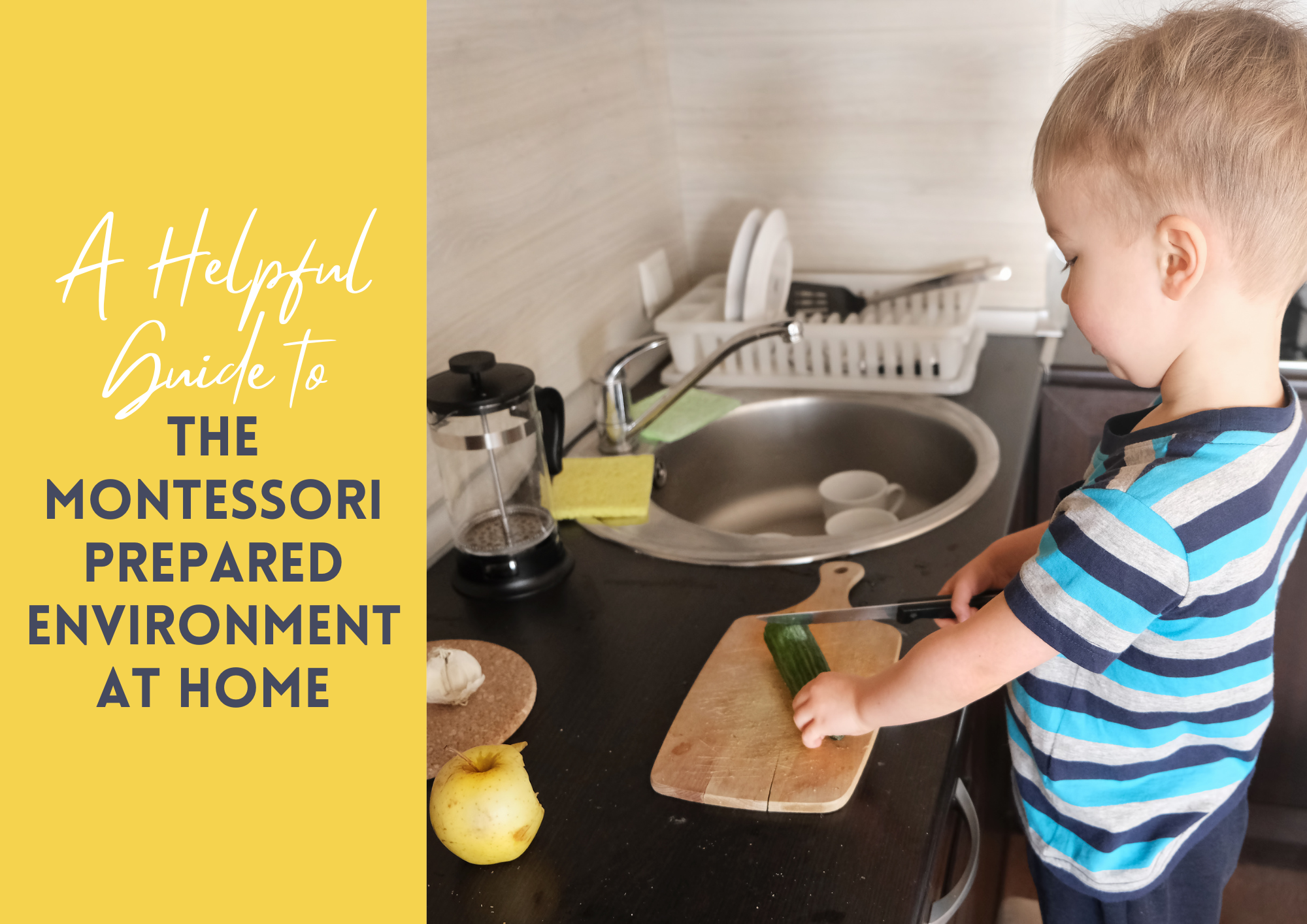
- Child-sized kitchen tools, such as children’s knives, if you want your child to help you will meal prep and cooking
- Child-sized furniture, such as table and chair for dining on, or a chair they can easily climb into to join the family at a larger dining table
- Access to a snacks drawer with limited options chosen and provided by you
Bathroom
- Step stool to allow your child to access the sink
- Easy to reach toothbrush and towels
- Mirror hung at child height
- A support system for accessing the toilet, e.g. a step stool or child toilet seat
- Child-friendly visuals, e.g. steps in the bathroom routine, or stages of making wudu (ablution)
Living room/main area
- Low open shelves
- Carefully selected toys/materials (these can be rotated with other toys every so often to keep options limited and interest fresh!)
- Beautiful artwork, ideally hung at child height
- Front-facing bookshelf with small selection of books
- Prayer mats in easy reach, ideally, child-sized
Bedroom

- (Depends on age) Floor bed or low bed that is easy to climb in and out of
- Clothes that are easily accessible, e.g. in drawers which are labelled with a picture, or hung on a low clothes rail or hooks
- Easy access to Quran or Islamic audiobooks
- A space at child-height where they can see their faces in a mirror, brush their own hair, apply face cream, etc.
I hope this article gives you some helpful information and advice about what a Montessori prepared environment can be, its benefits for the child, and some inspiration for how you can implement it at home.
May Allah bless all your efforts, bring you closer with your children, and elevate you in success. Ameen.
Salaam x