
7 Easy Tricks to Make Worksheets Fun for Kids
Are you a sucker for a free fun worksheet? I am.
Those delectable freebies are all over the internet and man, they look so good! Those clever, enticing phrases draw me in:
‘Just print and go!’
‘No more planning!’
‘Independent learning!’
‘Perfect for preschool!’
‘Time saving!’
You’ve seen them, right?
So I go ahead, click and download, print, present them to my child and what happens?
She engages for a few seconds and then she’s done. Ouch. What a waste of printer ink.
Here’s the thing: worksheets are often developmentally inappropriate for very young children. Even the ones that are supposedly aimed at preschoolers or kindergartners.
Why are they developmentally inappropriate?
A few reasons:
- Most worksheets require the use of a pen or pencil
- Most worksheets do not encourage repetition – once they’re complete, they’re complete
- Most worksheets are not hands on or interactive (i.e. there’s little to no sensory experience for the child)
As a minimum, children aged 3-5 should have:
- learning experiences that engage at least one of the five senses
- the opportunity to repeat a skill to achieve mastery
- ideally, should not be forced to use a pencil until they demonstrate readiness and willingness (little hands do not develop the necessary bone structure and strength to hold a pencil with the proper tripod grip until around age 5-7)
But worry not, there are still ways you can use those fabulous freebies that litter the internet without falling into the traps I’ve listed above.
Through trial and error with my 4 year old, I’ve picked up some tried and tested tricks to make those free worksheets hands on and interactive WITHOUT the use of a pencil.
Here’s my list of 7 simple tricks to make worksheets FUN for your young child:
(This page contains some affiliate links at no additional cost to you if you choose to purchase.)
1. Use manipulatives to add sensory element to worksheets

Hands-on learning can’t be hands on without something for the hands to hold. That’s where manipulatives come in. Manipulatives are a collection of physical objects of the same type that a child can manipulate with their fingers – they can hold it, squeeze it, stroke it, pick it up, drop it – whatever their little hands are inspired to do.
This is most often used to encourage understanding of mathematical concepts like 1-to-1 counting, addition, subtraction, etc. But they can also be used to create patterns, make lines, trace shapes and letters, complete mazes, and so on.
Grab any kind of manipulatives you have at home and use it with the worksheets to increase the fun level for your child and help them engage with the learning concretely.
You could use little pom-poms, buttons, counters, lollipop/popsicle sticks, beads, mathlink cubes, legos and counting bears.
However, you probably don’t need to buy anything as you’re likely to already have manipulatives at home that would work just as well, such as:
– Popcorn kernels
– Dried beans
– Whole spices (e.g. star anise, cardamoms, cinnamon sticks)
– Coffee beans
– Paper clips
– Crayons
– Coins
You can even find materials outdoors if that’s your thing, such as pebbles, shells, twigs, acorns, pine cones, leaves, etc.
And the list goes on.
My personal favourite manipulatives to use to make worksheets more engaging are whole spices because there is the added excitement of the aromas to engage the sense of smell too!
2. Turn worksheets into fun cutting practice
Worksheets can sometimes seem so boring and flat, can’t they? So cut them up!
My daughter loves to practise her cutting skills (another fantastic fine motor exercise to strengthen the fingers).
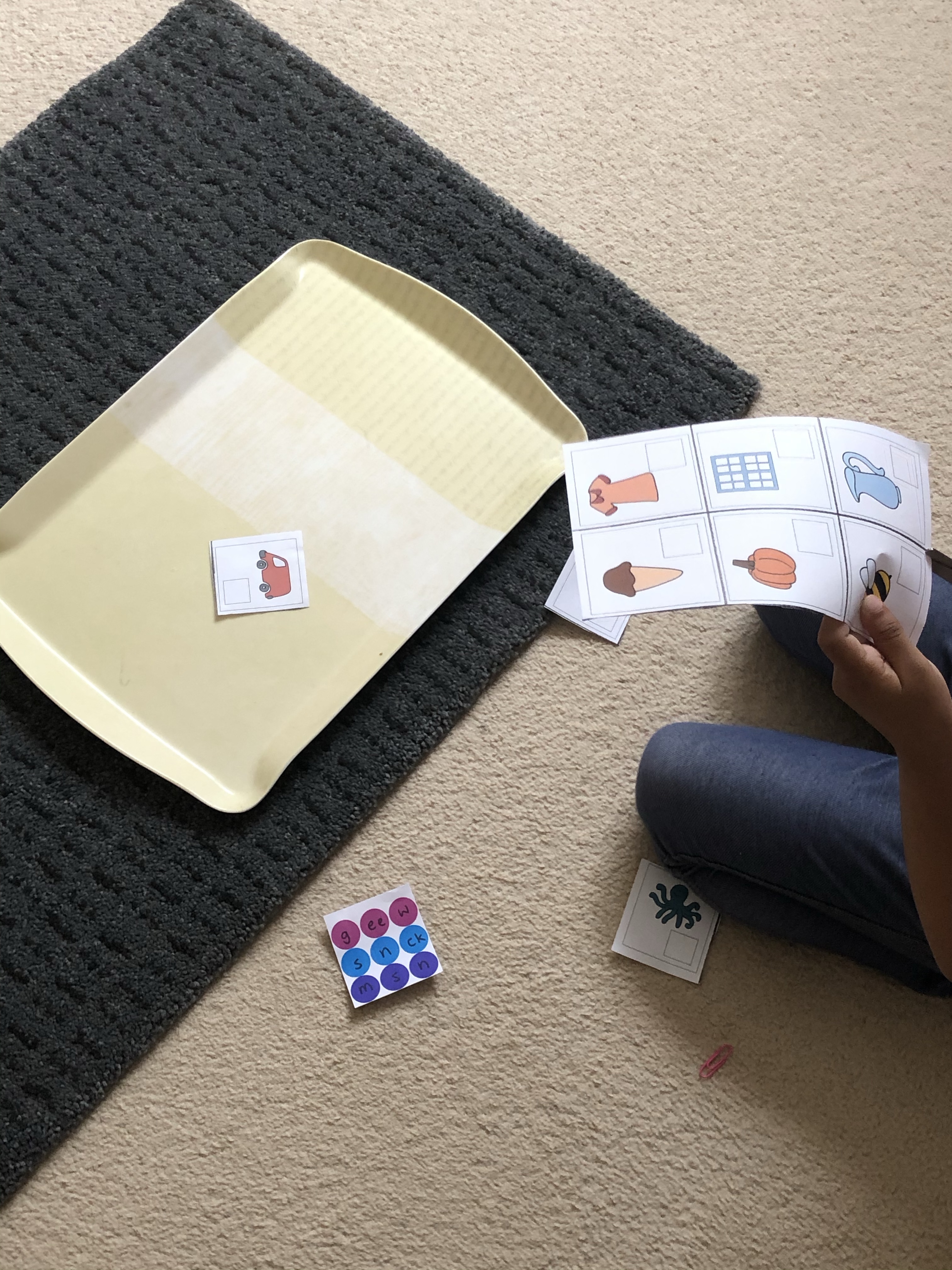
In the picture above, you can see a reading practice worksheet focusing on identifying ending sounds through a series of pictures; the child is meant to write the correct letter for the ending sound into the corresponding boxes.
Instead of using the worksheet as intended, I drew black lines around each image, allowed my daughter to cut them up (see image above), and then she got onto the actual language work after she was done.
As a result, she had slips of paper she could move around, and rather than one big sheet that she had to complete in the order given, she could choose to do it in whatever order she wanted.
See below for how we continued to make this worksheet even more hands on and exciting.
3. Make worksheets fun with stickers

I don’t know any young child who isn’t crazy for stickers. An added bonus is that it’s fantastic fine motor practice to strengthen their fingers for writing.
Stickers are also such a versatile learning tool. Plain dot stickers can be purchased online and are a staple in my home.
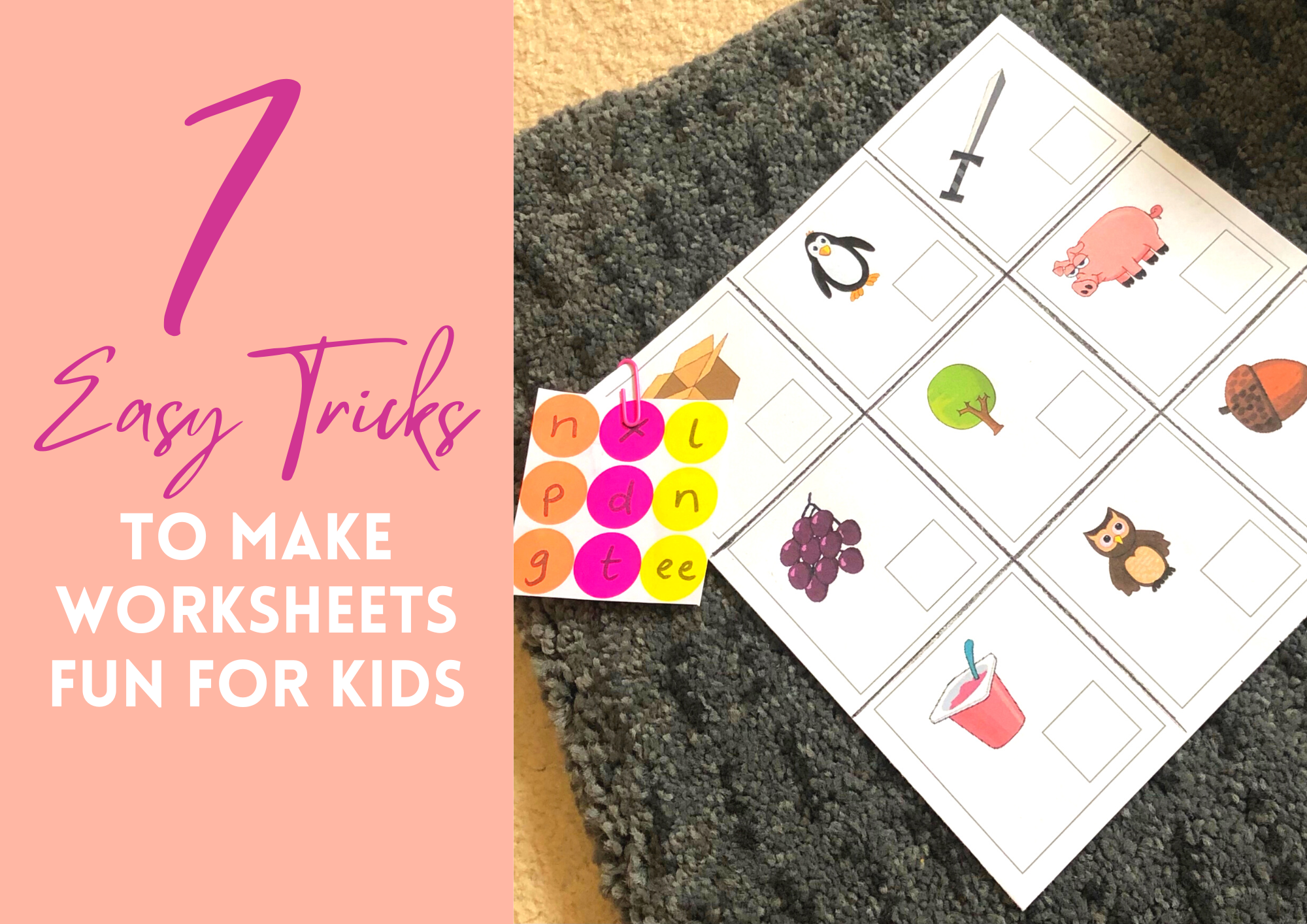
In the image above, the focus of the worksheet was to identify the ending sound of words. I gave my child stickers on which I had written out the letters she needed, and she happily got on with adding the sticker onto the right spaces of the worksheet. Before the sticker element, she was totally uninterested in completing this worksheet!
Using stickers to make worksheets fun is a gentle alternative to writing; my child can still do language work without having to use a pencil to do it.
There are tons of other ways to use stickers for learning. See my ultimate list of sticker activities for teaching language for loads of ideas you can try at home.
4. Use a movable alphabet alongside your worksheets
How can we encourage children who are showing readiness to read and make words without the pressure to write?
Use a movable alphabet!
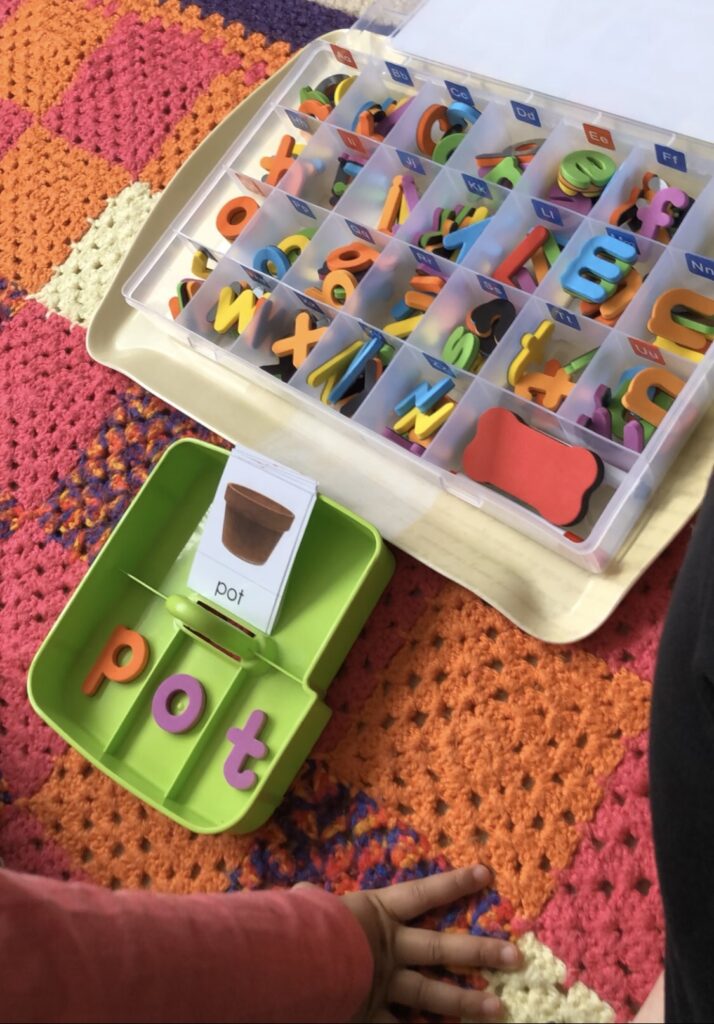
This is a quintessential Montessori material. All the letters are available to the learner in physical form and there are several of each one. This means that they can start building words and even sentences without the prerequisite of knowing how to hold a pencil properly or letter formation, which are additional skills that require a lot of work.
Again, you can make worksheets fun by repurposing them and using them repeatedly with this a movable alphabet, which is a fantastic, tactile material.
5. Use movable numbers with worksheets
Just like the movable alphabet, a numerical version is a must-have for those kiddies who know their numbers and can start doing more abstract maths, but haven’t yet got the strength to handle a pencil in the proper way.
This is the perfect material for those sums worksheets that can now be completed with ease and no pressure.
6. Repurpose worksheets by laminating or using plastic pouches

This is a good one for various reasons. My top two reasons for either laminating or placing worksheets into a plastic pouch is to: 1) allow for repetition of the work, 2) use other materials on top without worrying about the paper getting destroyed.
(Note: I tend to avoid laminating because it is so harmful to the planet, so I try to reuse my plastic pouches instead.)
A couple of things I’ve done using this trick is to allow the use of play dough on top to create patterns, letters, numbers, shapes, etc., use a whiteboard pen (if my child wants to) and rub out and try again, and use small manipulatives like pony beads to make shapes, lines, or in place of tracing.
7. Use sticky notes to add excitement to worksheets
I dare you to find me a young child who doesn’t enjoy hide and seek. Go on, I dare ya!
Here’s where sticky notes come in – I love using them to make the learning experience exciting. I place the sticky notes over a particular part of the worksheet and invite my child to uncover the secret.
A favourite activity of ours is to write a CVC word on top of the sticky note with the matching image underneath. My daughter would then read the word and lift the sticky note to see if she was right. This is also great for self-correcting because if the image doesn’t match what she reads, she can clearly see her mistake.
There are so many ways to use this trick – just play around with it to see what works!
I hope some of these ideas give you inspiration to make learning at home with your kids more hands-on and therefore more enjoyable, valuable and educational.
If you try any of these tricks, I’d love to know how it goes. Comment down below or tag/DM me on Instagram @salaammummy.
My recommended purchases (affiliate links)
1) 8mm Coloured Dot Stickers (2,100 total)

2) Reusable dry erase plastic pouches

3) Learning Resources Math Link Cubes

4) Learning Resources Set of 96 Coloured Counting Bears

5) Montessori-style movable alphabet – magnetic letters

5) Bulk-pack of sticky notes (Post-it notes)

Salaam x


